On 22 October 2026, the European Union formally terminated anti-dumping (AD) and anti-subsidy (CVD) measures targeting solar glass imported from China, bringing an end to 12.5 years of extra tariffs.
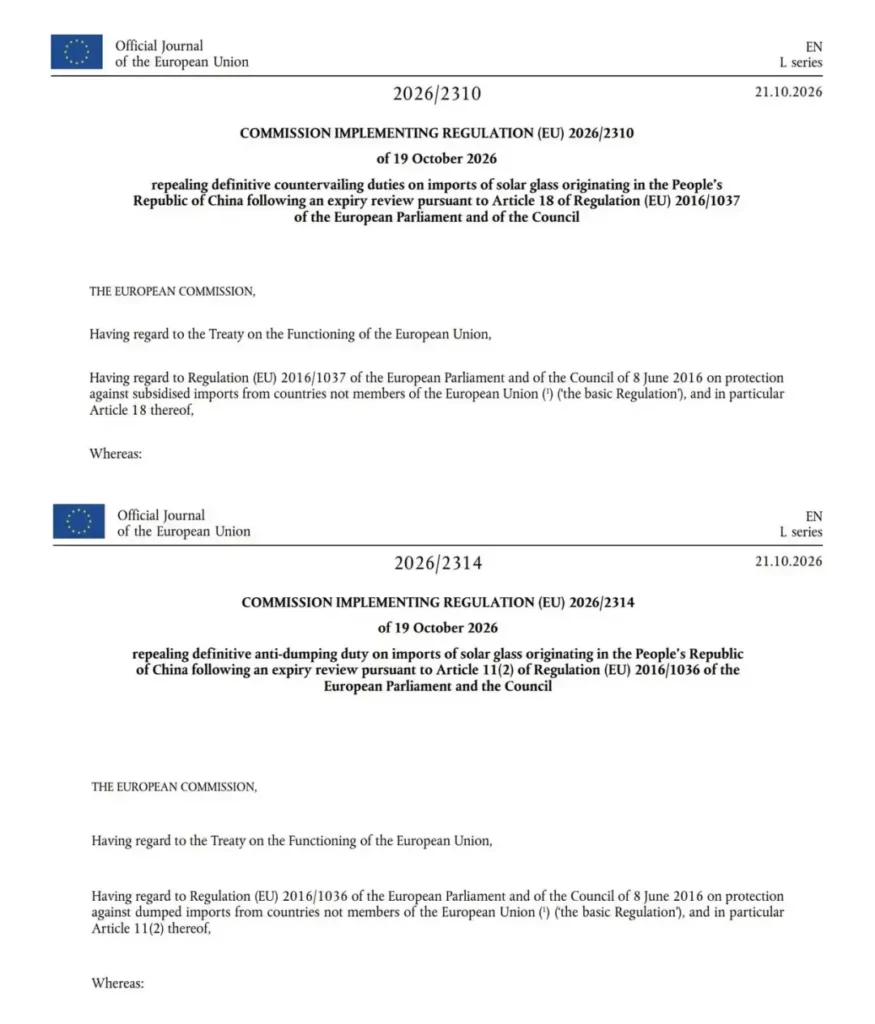
The European Commission adopted two regulations, (EU) 2026/2314 and (EU) 2026/2310, on 19 October to repeal the anti-dumping and countervailing duties respectively. The legal texts were published in the Official Journal of the EU on 21 October and entered into force the next day.
These trade restrictions were first introduced in May 2014. Under the old tariff scheme, Chinese exporters without an individual duty rate faced combined AD+CVD charges up to 84.2% on the customs value. For EU importers, this meant paying extra costs nearly equal to the cargo value, which significantly raised raw material costs for European module manufacturers and solar project developers.
A common misunderstanding: the EU’s decision to lift duties does not mean the authorities ruled out dumping or subsidisation. The core reason is straightforward: there are no operating solar glass manufacturers left inside the EU. Without a domestic industry to suffer injury, the trade remedy measures lost their purpose.
Germany’s GMB and Belgium’s AGC were the last two large-scale solar glass producers in the bloc. Both halted production in Q1 2025. GMB filed for insolvency in November 2025 and was fully shut down in March 2026. The expiry review was originally requested in April 2025 by Interfloat Group, parent company of GMB. However, the group failed to provide valid supply contracts, financing plans or viable restart proposals, and no third-party buyer emerged to take over the assets.
During the review, the Commission still used Turkey as the analogue country to calculate the normal value, and found dumping margins above the threshold. There was simply no local industry left to protect.
Important Rules for Duty Refunds
Alongside the repeal, clear refund arrangements are now available for EU importers:
- Duties paid from 22 July 2025 (the date the review was initiated) onwards are eligible for refund, without interest.
- Refund applications must be submitted within three years from the date of the customs debt notification.
- Taxes collected between 2014 and 21 July 2025 are non-refundable.
- The right to claim refunds belongs exclusively to EU-based importers, not Chinese exporters.
Market Outlook for Solar Supply Chains
In the short run, the removal of heavy tariffs restores the price competitiveness of Chinese solar glass in the EU market. European module makers and EPC contractors will enjoy lower procurement costs, creating new order opportunities for Chinese solar glass suppliers.
Longer-term, this case sends a strong signal: more than a decade of trade protection failed to sustain the EU’s domestic solar glass sector, while pushing up costs for the whole downstream solar ecosystem. It is critical to stay realistic: the withdrawal of these duties does not represent a general shift in the EU’s trade stance. Additional trade investigations and regulatory risks on other segments of the PV supply chain remain possible.
For solar exporters and overseas buyers, the EU window has reopened. Still, compliance, documentation, refund procedures and customer due diligence should remain priorities. While capturing new business chances, prudent risk planning is always recommended.