By the end of July 2026, China’s cumulative installed photovoltaic capacity reached 1.286 billion kilowatts, officially surpassing coal-fired power to become the country’s largest power source for the first time in history. Despite the record-breaking installation figures, the solar manufacturing industry is undergoing a drastic capacity consolidation cycle. Leading PV module manufacturers reported collective losses in their half-year financial reports, marking the start of a brutal industry reshuffle. For overseas solar EPCs, distributors and procurement buyers, understanding this industry cycle is critical to avoiding supplier defaults, delivery failures, and long-term quality risks.
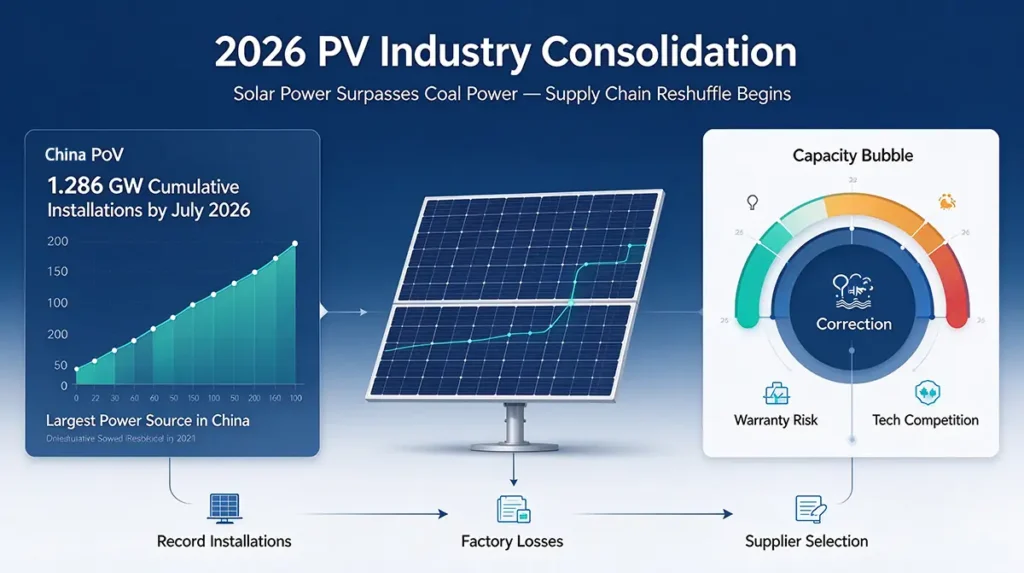
1. Capacity Bubble: Global PV Output Far Exceeds Actual Demand
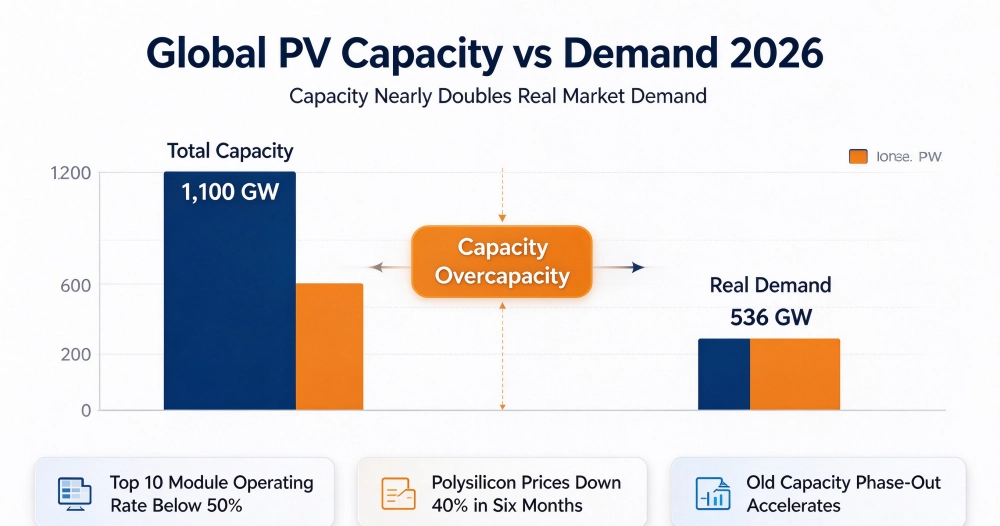
In 2026, global PV module demand stands at approximately 536GW, while the total global production capacity hits 1,100GW — nearly double the real market demand, leaving massive production lines idle. The average operating rate among the top 10 module manufacturers falls below 50%, while production cuts and factory shutdowns have become common for mid and small-sized manufacturers.
Previous large-scale capacity expansion has created enormous redundant production capacity. Across the entire industrial chain — polysilicon, silicon wafers, solar cells, and modules — production volumes declined simultaneously in the first half of 2026, signaling the official start of the industry’s bubble correction phase.
2. Prices Fall Below Cost: Hidden Supply Chain Risks Behind Ultra-Low Pricing
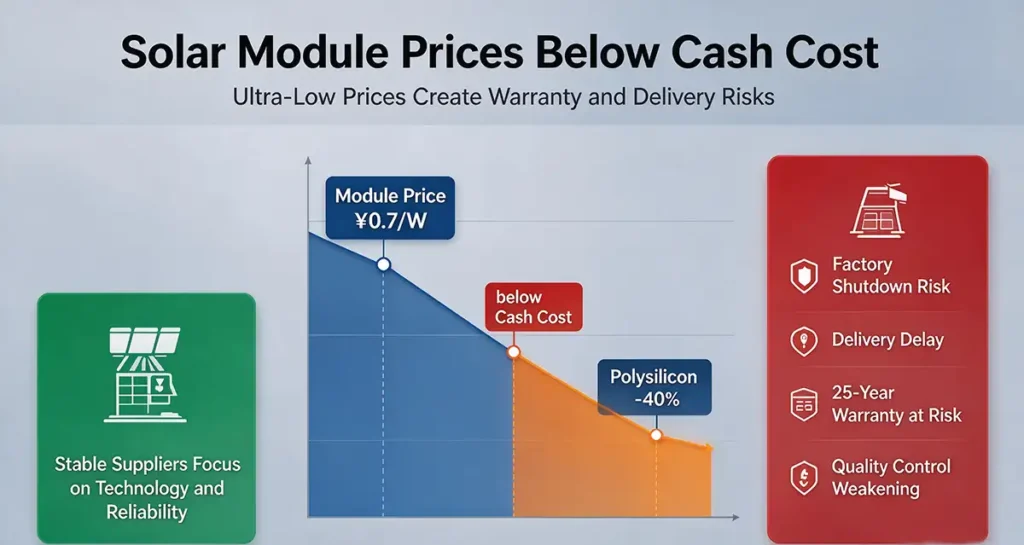
Overcapacity has triggered a continuous downward price trend across the PV market. Polysilicon prices dropped by 40% within six months, and module bidding prices once fell below ¥0.7 per watt — a level lower than the cash production cost for most manufacturers. Many factories suffer losses on every module produced, failing to cover raw material, labor, and operational expenses.
Key takeaways for overseas buyers: Ultra-low-price modules do not equal high cost performance. Manufacturers operating under sustained losses face high risks of production reduction, factory suspension, and warranty default. Once a manufacturer exits the market, its 25-year linear power warranty and after-sales commitments will become unenforceable. The current price decline is driven by supply surplus and is unlikely to reverse in the short term.
3. Industry Prisoner’s Dilemma: Higher Shipment, Larger Losses
The global PV industry is currently trapped in a typical prisoner’s dilemma. Expanding shipment volume leads to greater overall losses, while cutting production results in lost market share. Although top-tier manufacturers maintain leading shipment volumes, they also record the largest losses. The era of profit growth through blind capacity expansion and scale expansion has come to an end.
4. Export Market Dividend Fades: Overseas Demand Loses Momentum
Overseas markets were once the core growth driver for Chinese PV manufacturers. In H1 2026, China’s total PV export value increased by 24.3%, mainly boosted by solar cell exports, while module export volume showed a slight decline.
Starting from April 2026, the cancellation of PV module export tax rebates prompted overseas buyers to place bulk advance orders, effectively overdrawing future market demand. Meanwhile, inventory levels in European and American markets remain high, leading to shrinking new orders. With both domestic and overseas demand under pressure, the low-price-driven export model has reached its ceiling.
5. New Policy Thresholds Accelerate Obsolete Capacity Phase-Out
In the past, the industry relied on self-regulation to ease vicious price competition. Currently, official mandatory policies have been introduced to accelerate industry consolidation:
- The official implementation of the General Principles for PV Industry Cost Accounting Model unifies cost calculation standards across the entire industrial chain.
- Mandatory national PV energy efficiency standards will take effect in 2027, establishing three-tier market access thresholds. Outdated production lines that fail to meet standards will be completely phased out. The new energy efficiency rules alone are expected to eliminate 310GW of backward capacity.
In the future, only manufacturers that meet strict energy consumption and efficiency standards can survive and compete in the mainstream market.
6. Technology Premium: BC and Perovskite Define Long-Term Industry Competition
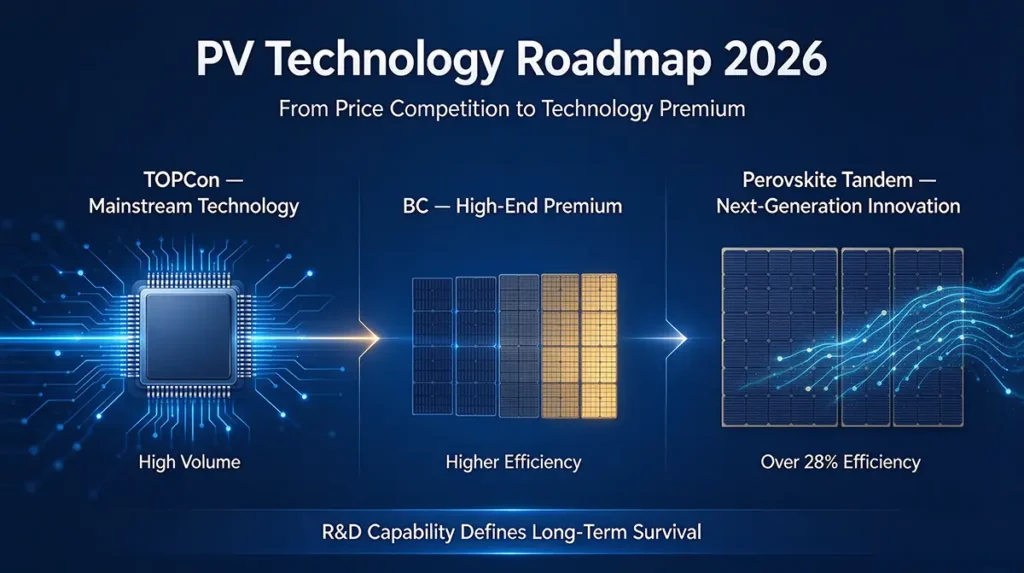
Amid fierce price wars, technological advantages and product premiums have become the core moat of high-quality manufacturers. The market share of BC (Back Contact) high-efficiency modules has risen rapidly in 2026, with average bidding prices higher than mainstream TOPCon modules. Project owners are increasingly willing to pay a premium for higher conversion efficiency and better power generation performance.
In the long run, perovskite tandem technology represents the next-generation PV innovation direction, with mass production efficiency exceeding 28% and expected large-scale commercialization by 2028. The current industry pattern is clear: TOPCon serves as the mainstream basic technology, BC dominates the high-end market, and perovskite tandem technology will define the future of the PV industry.
This industry reshuffle is eliminating manufacturers that rely solely on capacity expansion without continuous technological iteration capabilities.
7. Buyer’s Guide: How to Select Stable & Reliable PV Suppliers
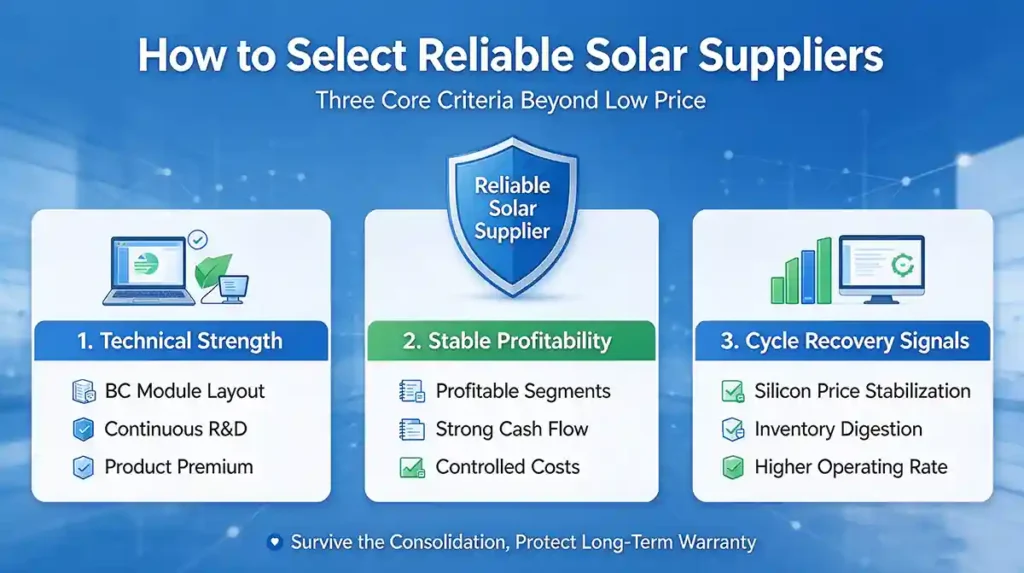
Global long-term PV demand remains on an upward trajectory. The industry is not facing shrinking demand, but undergoing profound capacity restructuring. Overseas buyers should no longer prioritize low prices alone. Instead, supplier selection should focus on three core indicators:
- Sustainable technical strength: Suppliers with independent R&D capabilities and high-efficiency product layouts such as BC modules, capable of continuous technological iteration and maintaining product premium value.
- Profitable segmented tracks: Prefer suppliers with stable profitability in segmented sectors including solar inverters, PV encapsulation films, and diamond wires, with stronger anti-cycle risk resistance.
- Cyclical recovery signals: Judge supply chain stability based on silicon material price stabilization, industrial inventory digestion, and rising factory operating rates.
Conclusion
The milestone of PV installed capacity surpassing coal power does not mark the end of the industry’s development, but ushers in a new era. The PV industry is shifting from blind capacity expansion and vicious price competition to high-quality competition centered on technology, product quality, and long-term reliability. In this round of industry elimination, the surviving enterprises will no longer be those with the largest production capacity, but those with controllable costs, continuous innovation capabilities, stable delivery performance, and reliable long-term warranty fulfillment systems.
Data Sources: National Energy Administration, China Photovoltaic Industry Association, Wind, SMM, Jinkoo Research, ITRPV, Listed Company Financial Announcements
Disclaimer: This article is for industry reference only, providing objective market analysis and no commercial promotion.
Need trusted solar products for your PV project?
Submit your inquiry via the form below.
We offer competitive prices, stable supply and high quality solar products for overseas solar buyers.