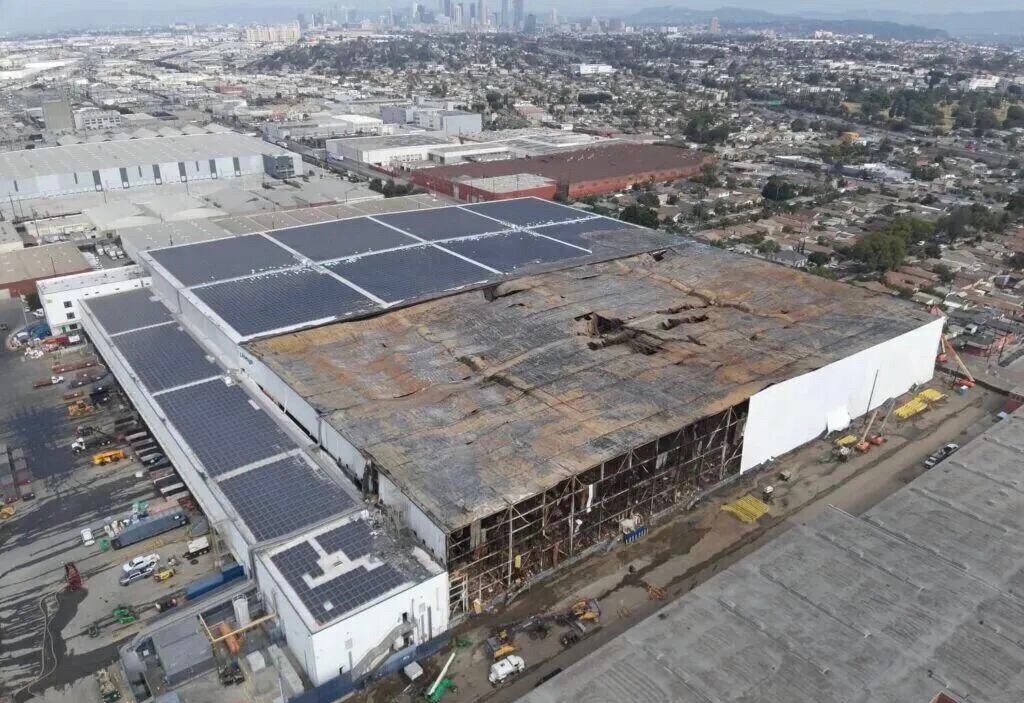
The PV industry has witnessed a textbook commercial rooftop solar accident. It is not a simple broken panel or inverter alarm. A rooftop photovoltaic fire burned continuously for eight days, forcing Lineage — the world’s largest temperature-controlled warehousing operator — to declare an emergency at its Los Angeles cold storage facility.
The disaster destroyed 85 million pounds of frozen goods. Site remediation alone cost more than $100 million. Lineage filed a lawsuit against solar asset owner Altus Power and O&M contractor Pearce Services, seeking more than $1 billion in compensation.
For solar developers, EPC contractors and O&M providers, this case is far more than news gossip. It lays bare the biggest risks of commercial rooftop solar projects all at once.
Where the Fire Started: Rooftop PV Array
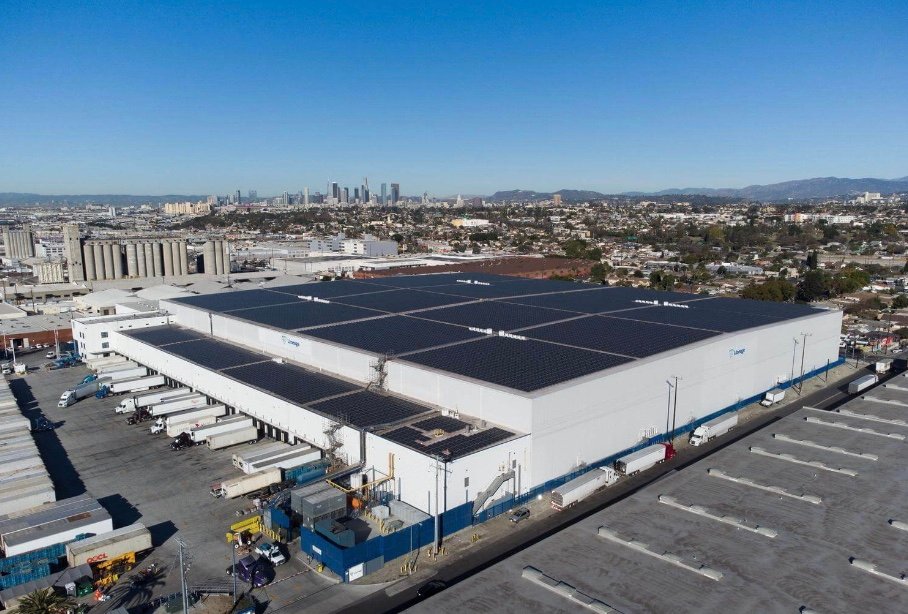
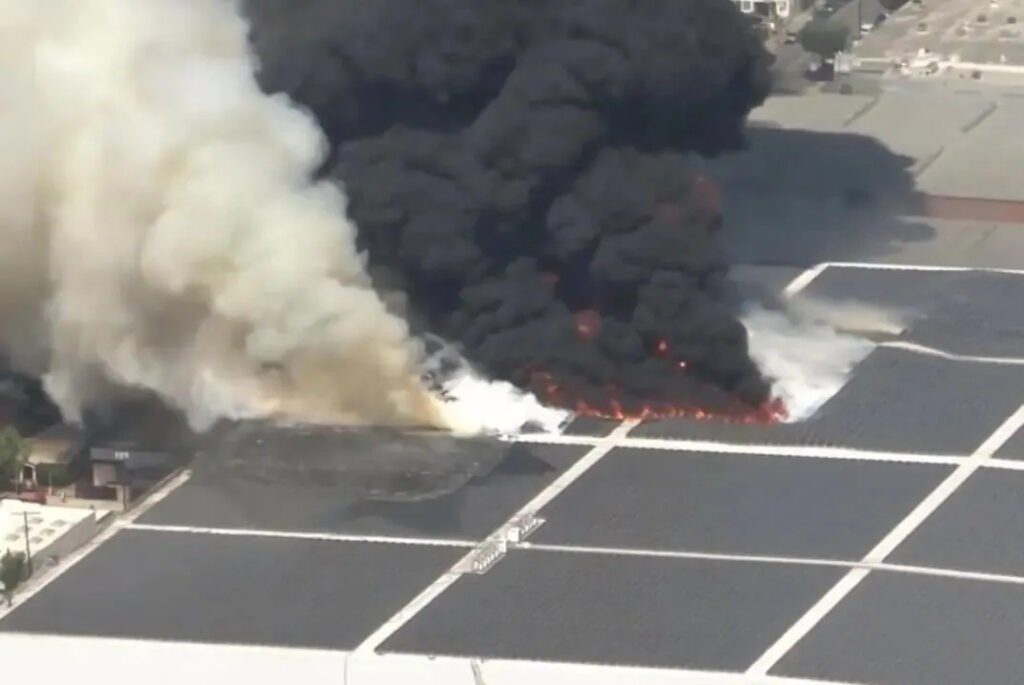
On June 17, 2026, fire broke out on the rooftop of a 500,000 sq ft cold storage warehouse in Boyle Heights, Los Angeles. According to Lineage’s complaint, the fire ignited while contractors were inspecting and servicing the rooftop solar array.
The array already had a poor safety record. A smaller fire broke out on the same PV system back in August 2024. Subsequent inspections found over 200 connector failures by May 2026, within the exact section where the major fire later started. Issues included loose bolts, mismatched jumpers and failed PV connectors.
PV professionals know clearly: mismatched MC4 connectors, improper jumper wiring, poor crimping and loose contacts with water ingress are classic triggers for DC arcing and ignition.
Critical Mistake: Re-energization Before Completing Safety Tests
Lineage stated in writing on June 11 that the solar array must NOT be re-energized before finishing mandatory safety testing and voltage verification.
Nevertheless, the lawsuit alleges Altus Power and Pearce Services reactivated the PV system between June 5 and June 17 despite this written order. On June 17, Pearce technicians performed work on the energized solar array, and the fire ignited.
This combination is lethal:
Live work + existing connector defects + written lockout order ignored = catastrophic solar fire.
PV modules generate dangerous high DC voltage under sunlight, even when the AC side is disconnected. Restoring power without IR thermal scanning, insulation resistance testing, arc flash assessment and connector torque checks is extremely reckless.
Defendants’ Response
Altus Power argued the complaint contains substantial factual errors, claiming Lineage tries to shift liability for warehouse material release and contamination costs onto the solar side. Pearce Services said the official root-cause investigation has not concluded, so blame cannot be assigned prematurely.
From an industry perspective, cold storage warehouses carry unique hazards: ammonia refrigerants, flammable polyurethane insulation and packaging materials that produce heavy toxic smoke and repeated re-ignition. The final fire cause awaits the official fire department report.
Still, if the evidence of “200 known connector faults while keeping the array energized” holds up in court, the solar side will face huge liability pressure. This disaster may be a compound failure: PV defects as the ignition source, warehouse hazards amplifying the blaze, plus inadequate emergency response.
Key Lessons Every Solar Practitioner Must Learn
1. PV Connectors are not trivial accessories, they are safety bottlenecks
The industry saying goes: modules determine efficiency, connections decide system safety.
DC circuits have no zero-crossing point, meaning DC arcs are extremely hard to extinguish. Mismatched connectors, makeshift jumpers, insufficient torque and mixed brands create constant fire hazards.
2. Early commercial rooftop PV projects enter “debt repayment period”
Many older distributed rooftop PV projects prioritized fast installation and power output over regular inspection and thermal scanning.
As these systems reach 5–10 years of operation, aging connectors, degraded cables and roof waterproofing failures surface together. Preventative O&M cannot be skipped.
3. Strict closed-loop lockout & energization procedures are mandatory
Verbal messages like “do not turn it on” via chat are never enough. Formal work orders, signed permits and lockout-tagout (LOTO) rules are required.
Pre-energization checklist: insulation test, polarity check, grounding verification, connector torque inspection, string current deviation test, arc-fault protection validation and removal of combustible rooftop debris.
4. Clarify liability boundaries in contracts before project kickoff
This lawsuit is a brutal reminder for commercial rooftop PV contracts. Parties must clearly define:
- Who has authority to approve energization
- How quickly faulty strings must be shut down
- Responsibility if connector rectification is blocked by the building owner
- Insurance coverage for fire, third-party property loss and business interruption
- Whether O&M contractors carry professional liability insurance
Final Takeaway
Rooftop solar is viable for cold storage and factory buildings — but “install and forget” maintenance is no longer acceptable.
This 8-day fire and $1 billion claim send a strong warning to the whole PV sector: Cutting corners on connector re-torque and inspections can bankrupt an O&M company.
If you are looking for reliable PV modules with strict quality control and safety performance for commercial rooftop solar projects, contact us for detailed datasheets and technical support.